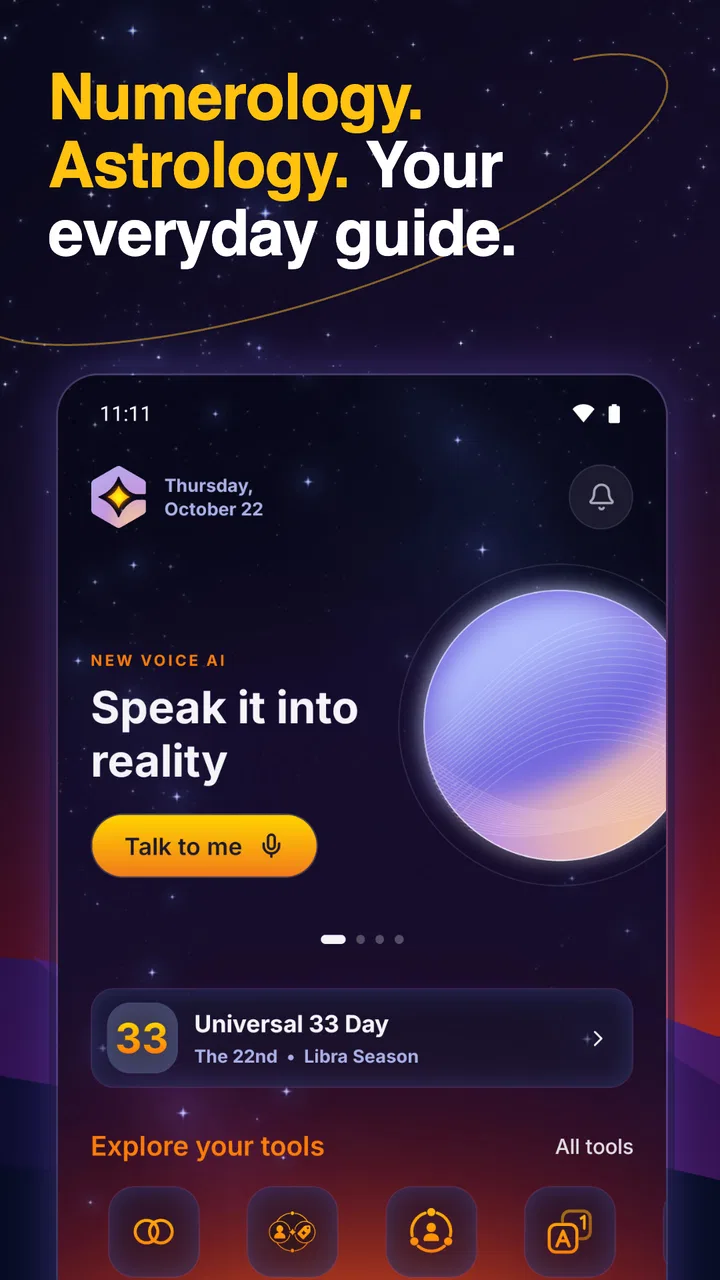
CUE Astrology
- 4.7
- Rating
- 100.00K
- Installs
- Free
- Price

 Analysis by App-foxy
I approached CUE Astrology as a lifestyle app rather than a quick horoscope toy. Developed by GG33, it brings astrology and numerology together in one place, which makes it useful for people who enjoy reflecting on personality, timing, and personal patterns without switching between separate tools. My first impression was that it is easiest to appreciate when I treat its readings as prompts for thought, not as instructions that should make decisions for me.
The app is free to download and aimed at Everyone, so the basic idea is approachable even if you are new to both subjects. It has also attracted a 4.7 average from around 9.3K ratings, alongside over 100K installs. Those figures suggest that it has found a clear audience, but they do not remove the need to decide whether its style matches the way you like to use spiritual or self-reflection apps.
How I use the app as a daily reflection tool
My most useful routine starts with a short visit rather than trying to consume everything at once. I open a reading when I have a particular question in mind, such as whether I need to slow down, communicate more clearly, or pay attention to a recurring feeling. That small change matters. Instead of asking the app to predict my entire day, I use it to frame a subject I was already considering.
You May Also Like

 Pandora - Music & Podcasts
Pandora’s Music Is Easy to Start, but Harder to Recover
Pandora’s strength is its low-effort path from a seed to a station. Its weak spot is how much confidence it asks you to place in connection, setup, and quiet recovery.

 AccuWeather: Weather Radar
AccuWeather Review: A Quick, Clear Forecast for Everyday Decisions
For everyday plans, the best forecast is the one you can understand quickly. AccuWeather makes rain timing, radar, and local conditions easy to act on, with a few trade-offs.

 Hill Climb Racing
Why Hill Climb Racing Still Turns Crashes Into One More Run
A tiny car, a bumpy hill and one more upgrade: Hill Climb Racing keeps resurfacing because its simple chaos makes every near-miss feel personal.

 AliExpress - Shopping App
AliExpress Makes Global Shopping Feel Personal, but Shoppers Bear the Risk
AliExpress turns a global marketplace into a pocket-sized discovery engine. Its reach is useful, its shopping loop compelling, and its trade-offs easy to miss.

 Lords Mobile: Kingdom Wars
Lords Mobile Is a Kingdom-Building Routine, Not a Quick Match
A case-by-case verdict on the building, battles, device demands, and social commitments that make Lords Mobile rewarding for some players and exhausting for others.

 PDF Scanner app - TapScanner
TapScanner Makes Paperwork Easier to Capture, Check, and Share
TapScanner makes scanning with a phone feel less like a rescue operation and more like a dependable step in getting work done. Its capture tools are useful, though not flawless.
More From Our News Desk
View All News


The combination of astrology and numerology gives the experience a broader feel than a single-format horoscope app. Astrology encourages me to think about cycles, signs, and general influences, while numerology offers another way to interpret dates or personal patterns. I do not see the two systems as interchangeable, and I find the app more interesting when I compare their perspectives rather than treating every statement as equally precise.
A realistic everyday use case is a quiet check-in before planning a busy week. I might read the available guidance on a Monday morning, note one or two themes that feel relevant, and then return later to see whether they helped me notice anything in my own behavior. I would not use it to choose a job, end a relationship, or make a financial commitment. For those decisions, practical information and conversations with the right people are far more important.
That boundary is one of the most important habits for getting value from this kind of app. The strongest readings are often the ones that help me ask a better question. If a message suggests patience, I can use that as a reminder to reread an email before sending it. If it points toward communication, I can check whether I have been assuming that other people understand what I mean. The useful action comes from my response, not from blindly following the reading.
What to prepare before relying on the experience
I recommend setting aside a few minutes when you first open the app instead of rushing through the first screen. Explore how the information is presented, notice which parts are personal and which are broader, and decide what kind of reading you actually want from the session. This prevents the common mistake of opening an astrology app only when anxious and then interpreting every line as an urgent warning.
It is also worth keeping a simple private note of the messages that genuinely stand out. I do not mean recording every sentence. A short line such as “watch my reactions in conversations” is enough. After a few visits, I can compare the app’s prompts with what actually happened in my week. This turns passive scrolling into a repeatable reflection habit and helps me separate useful observations from statements that simply sound familiar.
Another practical approach is to read once, close the app, and return later with fresh eyes. Re-reading immediately can make a vague idea feel more important than it is. A short gap gives me room to decide whether a suggestion connects with my real circumstances or whether I am forcing a connection because I want an answer.
Settings and choices I would check early
The most valuable “settings” here are not complicated technical adjustments. They are the choices I make about how I interpret and organize the material. I first check which parts of the app I am comfortable using and whether I want to engage with both astrology and numerology or focus on one at a time. Separating them can make the experience clearer when I am trying to understand which style of guidance I find more helpful.
I also pay attention to the difference between a general message and something that feels personally relevant. A broad statement can be a useful journal prompt, but I do not treat it as a customized conclusion about my life. This distinction is especially helpful for new users, because astrology language can sound specific even when it is open to several interpretations.
Before spending money, I would explore the free experience long enough to understand the app’s tone and usefulness. The app is listed as free, while in-app purchases range from $9.99 to $999.99 per item. That is a significant range, so I would not tap through a purchase screen casually. I would read exactly what an item offers, confirm the amount, and decide whether it adds something I will genuinely use rather than buying because a reading has made me curious or emotional.
This is also where the app differs from a basic free horoscope page. A web search may give me a quick daily message with no commitment, while CUE Astrology is better suited to someone who wants one recurring place for astrology and numerology. The trade-off is that a dedicated app can encourage more regular engagement, which is helpful for reflection but less helpful if I already tend to check spiritual content compulsively.
The current version is 2.0.10, and the app supports Android seven point zero and later. That makes compatibility worth checking before downloading on an older device. I would also keep the app updated through the normal store process, since a current version is generally the sensible starting point when evaluating how smoothly an app behaves.
Shortcuts that make the routine more useful
My favorite shortcut is not a button; it is a question template. Before opening a reading, I write one sentence beginning with “What would help me notice…?” For example, I might ask what would help me notice impatience during a difficult conversation. This keeps the session focused and stops me from jumping between every available interpretation.
A second efficient pattern is to use the app at fixed moments rather than whenever I feel uncertain. A morning check can help me choose a mindset for the day, while an evening visit can help me review what actually happened. I would avoid doing both automatically at first. One intentional session is easier to evaluate than repeated checking, and it reduces the chance that I will search until I find a message that confirms what I already want to believe.
I also find it useful to pair a reading with one concrete action. If the theme concerns organization, I can clear one small task from my list. If it concerns relationships, I can ask a direct question instead of guessing. This is a subtle but important trade-off: the app can provide a reflective starting point, but it cannot replace the work required to change a habit.
For people who enjoy journaling, a three-line format works well. I note the main theme, the situation it reminded me of, and the action I chose. I do not need to copy the entire reading. Over time, this creates a personal record of how I respond to the app, which is more valuable than trying to prove whether every prediction was exact.
Experienced users may also benefit from alternating focus. One session can concentrate on astrology, while another can look at numerology, followed by a comparison in my notes. If both point me toward the same personal issue, I treat that as an invitation to reflect more deeply, not as double proof that an event will happen. If they feel different, I choose the interpretation that leads to the most practical and healthy action.
Where the app is strong, and where I stay cautious
The clearest strength is the way it puts two related systems into a single lifestyle experience. Someone who already enjoys astrology but is curious about numerology can explore both without maintaining separate routines. I also like that the app can fit into a short pause. It does not have to become a long reading session, and that makes it easier to use as a gentle prompt during an ordinary week.
Its main limitation is inherent in the subject matter: readings can feel personally meaningful while still being open to interpretation. Users who want measurable, testable answers will probably find the experience unsatisfying. A conventional planning app, mood tracker, or evidence-based mental health resource will be a better choice when the goal is to monitor behavior, manage tasks, or address serious emotional difficulties.
I would also skip it if I know I am vulnerable to making major choices based on predictions. The Everyone age rating makes it broadly accessible, but accessibility is not the same as suitability for every situation. Younger users and anyone dealing with anxiety should use extra judgment and talk to a trusted person when a reading makes them worried.
Compared with a standard horoscope app, CUE Astrology feels more appealing to users who want numerology included in the same experience. Compared with a numerology-only tool, it offers a wider interpretive starting point. Compared with a journal, it supplies prompts rather than asking me to generate every question myself. The journal remains better for tracking real events and feelings, while this app is better at giving me a fresh angle when my own reflection feels repetitive.
Questions I would answer before installing
If you are wondering whether it is free, the app itself is free, but optional purchases are available and can be expensive depending on the item. I would explore the main experience first and treat every purchase as a separate decision. Do not assume that curiosity created by a reading is a reason to buy immediately.
If you are asking whether it is suitable for beginners, I think it is, provided you are comfortable with open-ended language. You do not need to know every astrological or numerological concept before trying it. I would start with one system, use plain-language notes, and avoid searching for a definitive answer to a complicated personal problem.
If you want to know whether it can replace a horoscope, numerology tool, or journal, my answer is no single replacement works for everyone. It can combine the first two styles in one place, but a journal remains more flexible for recording personal experience. A calendar or task manager is also better when you need reminders, deadlines, and concrete planning.
If you are concerned about using it responsibly, the best rule is simple: use readings as prompts, not commands. Check them against your circumstances, take useful practical action, and ignore anything that encourages fear or reckless decisions. That approach lets me enjoy the reflective side without handing over control of my choices.
Finally, if you are using an older Android phone, check compatibility because the minimum operating system is Android seven point zero. The app was released on May 28, 2024, and its current version is 2.0.10, so I would begin with the current store version rather than relying on an old installation file.
My verdict after building a repeatable habit
I see CUE Astrology as a focused companion for people who enjoy spiritual self-reflection and want astrology and numerology together. Its real value appears after I stop chasing instant certainty and build a small routine around it: ask one question, read with distance, write down one useful theme, and connect that theme to a practical action.
GG33 has created an approachable lifestyle app with a strong appeal for curious beginners and existing astrology users. The 4.7 average and over 100K installs show that many people are engaging with it, while the free entry point makes trying it straightforward. Still, the broad in-app purchase range means I would be careful with spending, and the interpretive nature of the readings means I would never use them as a substitute for professional advice or grounded decision-making.
My recommendation is therefore specific: try it if you want a regular prompt for journaling, mindfulness, or personal questions, especially if having numerology beside astrology sounds useful. Skip it if you need factual forecasting, structured productivity tools, or clinical support. Used with healthy skepticism and a repeatable habit, this app works best as a mirror for reflection, not a map that decides where you go.
FAQs for CUE Astrology
01What is CUE Astrology and what can I use it for?
CUE Astrology is a horoscope and astrology app designed to provide personalized insights based on your birth information and current astrological influences. After setting up a profile, you can explore daily readings, personality-related interpretations, compatibility information, and other astrology content. It is best viewed as an entertainment and self-reflection tool rather than a source of guaranteed predictions or professional advice.
02How accurate are the readings in CUE Astrology?
The readings in CUE Astrology are generated from astrological traditions and the information you provide, such as your date, time, and place of birth. Their accuracy is subjective and depends on how closely you relate to the interpretations. The app can be enjoyable for discovering patterns, reflecting on relationships, or reading daily guidance, but its predictions should not be treated as scientifically proven facts or used as the sole basis for important life decisions.
03What information does CUE Astrology require during setup?
To create a more personalized astrology experience, CUE Astrology may ask for details such as your birth date, birth time, and birthplace. Some features can also involve profile preferences or relationship information. Providing a precise birth time may improve the app’s chart calculations, although you can still use the service if you do not know it. Review the app’s privacy policy before entering sensitive personal information.
04Is CUE Astrology free to download and use?
CUE Astrology may be available to download at no initial cost, but some readings, advanced features, or personalized content can be restricted to a premium subscription or in-app purchase. Before confirming a trial or subscription, check the pricing, renewal terms, and cancellation instructions displayed in the relevant app store. A free download does not necessarily mean that every feature is available without payment.
05Can CUE Astrology be used for relationship or compatibility advice?
Yes, CUE Astrology can be useful for exploring relationship themes, zodiac compatibility, and possible communication patterns, depending on the features available in your version of the app. These interpretations are general and should be used as conversation starters or entertainment rather than definitive judgments about another person. Healthy relationships still depend on communication, trust, boundaries, and real-life behavior.
Pros
- Clear daily
- weekly
- and monthly horoscope readings
- Covers multiple astrology topics in one app
- Personalized content based on your zodiac sign
- Simple interface that is easy to navigate
- Useful for casual astrology fans seeking quick insights
Cons
- Some features may require a paid subscription
- Predictions can feel broad rather than deeply personal
- Frequent notifications may become distracting
- Accuracy depends on how much you trust astrology
- Limited value for users seeking scientific guidance

CUE Astrology
Gallery